

Hantavirus Hoopla
Are we on the cusp of another pandemic?

I came across an interesting story in The Wall Street Journal this morning, “Scientists Have Finally Figured Out How Fast the Universe Is Expanding”. The subtitle made me smile:
“The most precise measurement of the expansion rate ever made suggests an unknown force may be affecting the universe.”
Ya think? I think Christians have a pretty good name for that “unknown force”.
The story adds weight to the reality that the more we come to know, the more we realize (or should realize) we don’t know. Every door of discovery unlocked swings open wide to reveal a thousand more doors behind it.
One would think, therefore, that as the universe expands, our capacity for humility (and attendant wisdom) would be expanding right along with it.
Alas, there’s not much evidence that we’re growing humbler, nor wiser. We seem, on balance, to be ignorant of Mark Twain’s famous maxim:
“It ain’t what you don’t know that gets you into trouble. It’s what you know for sure that just ain’t so.”
Take the frenzy that has erupted around the hantavirus outbreak on the MV Hondius, which has taken the lives of three people and which has authorities scrambling to monitor and trace the contacts of the 30-odd people from 12 countries who disembarked after the first person died (and before authorities realized they had and outbreak on their hands).
The Andes version of the hantavirus causing the current outbreak isn’t new: we’ve known about it for roughly 30 years. Like all hantaviruses, it’s sourced from rodent droppings, but it’s the only variant, as far as we know, that can spread by human-to-human transmission. But that requires close and sustained contact with infected persons, and there’s no evidence thus far that this variant is behaving any differently than in the past. The chance of this evolving into a pandemic is pretty close to zero.
That reality hasn’t done much to dampen the hyperbole colouring the headlines and spreading online. I get it, to an extent: hantavirus is a fearsome agent which kills roughly 30 per cent of its victims. And on the heels of a Covid pandemic that badly eroded the public’s trust in public health leadership, the World Health Organization’s assurance that the public is at low risk might ring a bit hollow. Add in the cruise ship at the centre of this story, and all the talk of contact tracing and quarantines, and one can be forgiven a touch of Covid-flavoured déjà vu.
But a pandemic this is not, and suggestions to the contrary are, at this stage, simply ridiculous.
The usual nutbars are coming out of the woodwork, of course. Take this post from Dr. Mary Talley Bowden, rabid Covid-era ivermectin peddler:
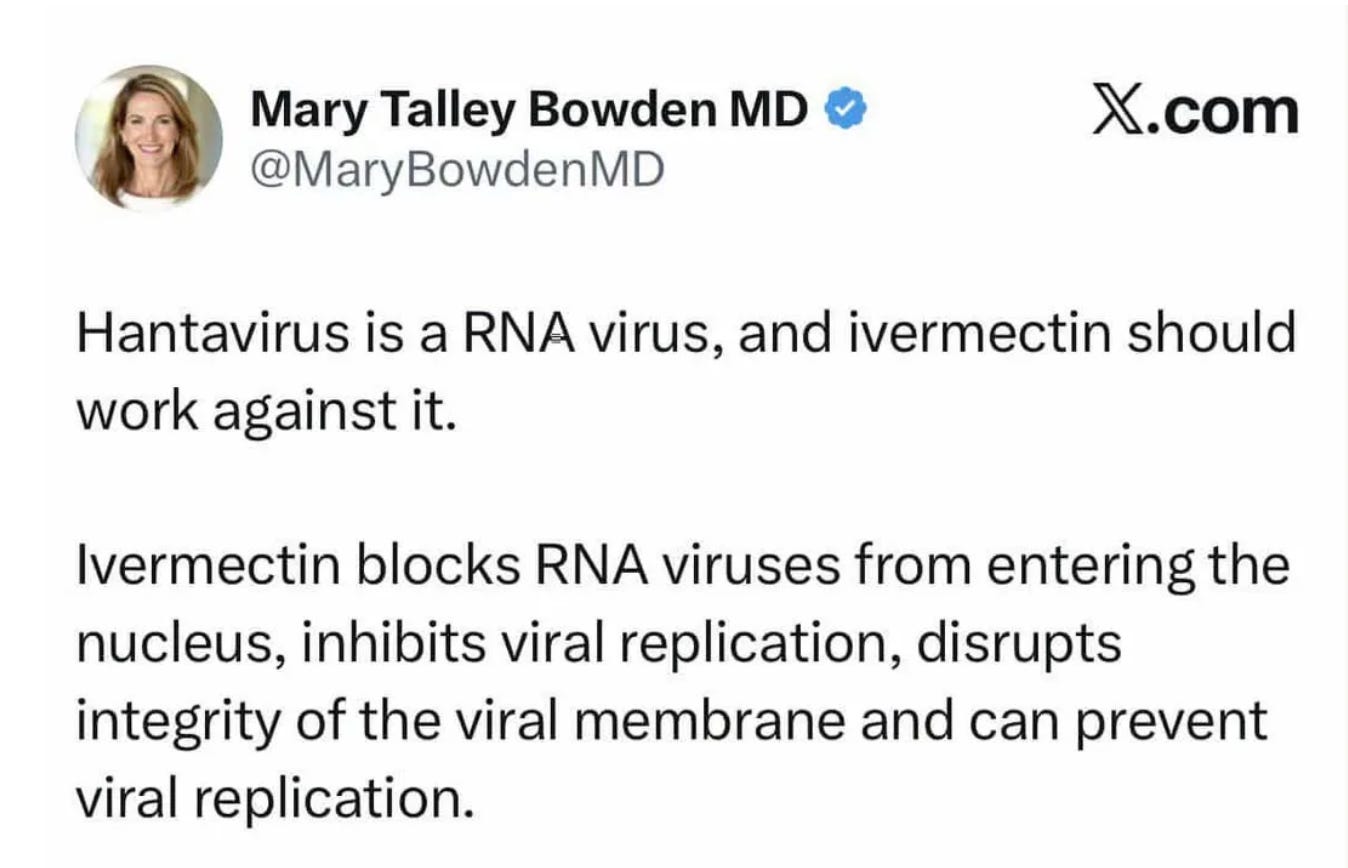
That bit garnered her 47,000 “likes”. But there’s a small problem with the good Dr. Bowden’s declaration (apart from stating twice in the same sentence that ivermectin halts viral replication): hantaviruses don’t enter the nucleus of host cells during their replication cycle. Hantaviruses are so-called “negative-sense” RNA viruses that replicate exclusively in the cytoplasm (the area outside the nucleus); their entire life cycle, including transcription (creating mRNA) and replication (creating new genomes), takes place in the cytoplasm. Which one might expect Dr. Bowden, as a graduate of medical school, to know (although as an ear, nose, and throat specialist, this sort of stuff isn’t exactly in her wheelhouse—all the more reason, therefore, for her to keep quiet; but that’d require a dollop of the aforementioned humility and wisdom).
More sensible is this chart, courtesy of Dr. Caitlyn Rivers at Johns Hopkins:
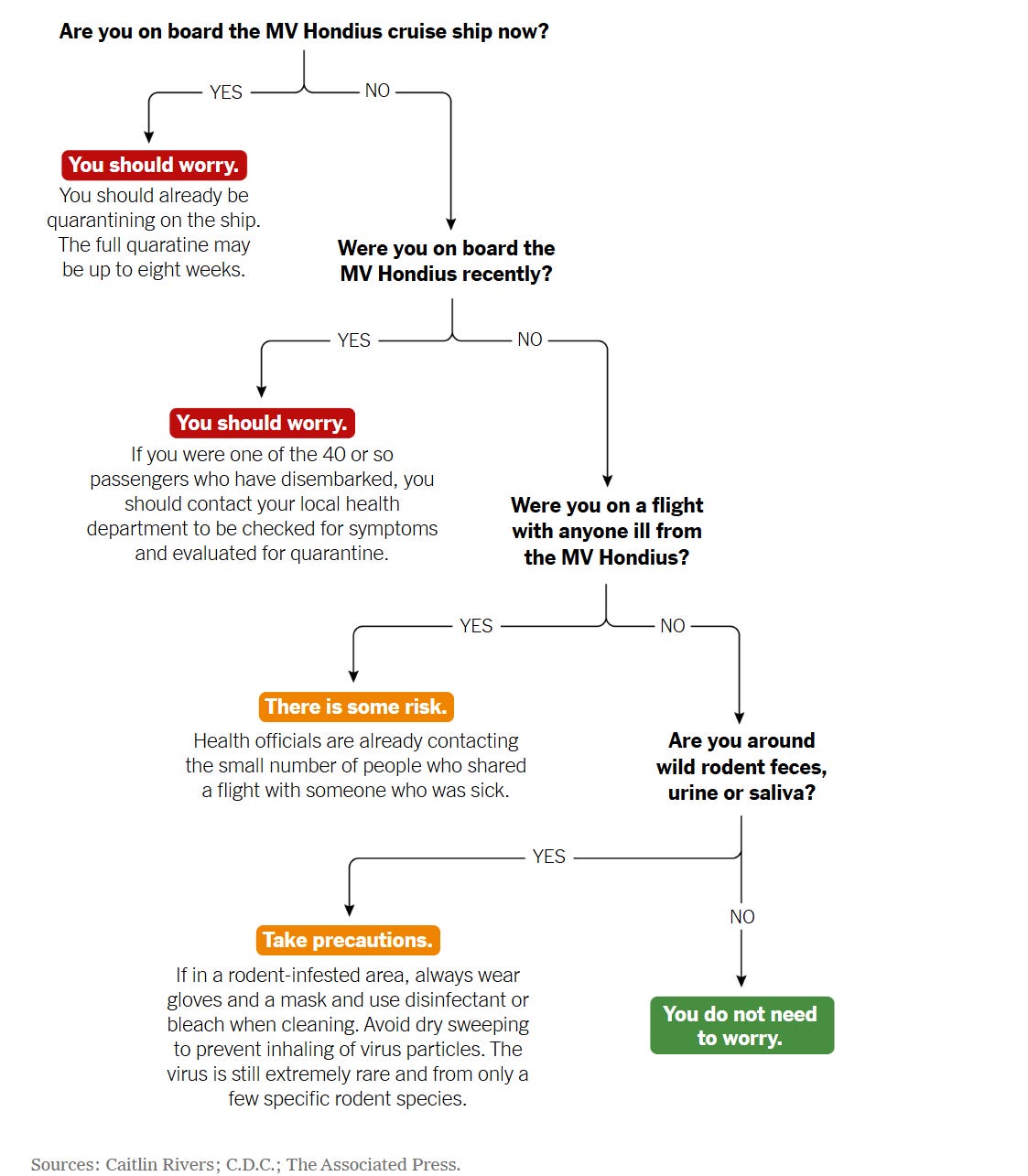
Got that? You do not need to worry.
So don’t run out and stock up on ivermectin just yet. Or on toilet paper, for that matter.
I have always enjoyed your clinical approach to medicine, more specifically medical care, extremely appropriate and you have a wealth of clinical experience from which you have learned a great deal about treating Patients! I know your back ground but could have guest you became a real doctor before you start into any specialty. Unfortunately that doesn't happen any longer in Canada at a lot of institutions but I can't speak about other countries. It's just my opinion but it does sadden me. Speaking as an old but not elderly surgeon IMHO.
Great points here Ed. It is weird how IVMT has become a cult obsession. If the government suppressed its use for COVID (which, whatever one believes about its effectiveness for COVID, it did) then it must cure everything from cancer to kidney failure to fatty liver and all infectious diseases. People have lost their mind about it.
As for the IFR of Hantavirus, I think the truth is we just don't know. We know the CFR is very high, but those are only the cases bad enough to come to medical attention. The IFR-CFR divide is very important, as studies by Jay Bhattacharya and others proved for COVID.